

Followers
602.8K
11K
Avg. views
0.11%
Engagement rate


673
Avg. likes
3
Avg. comments
213
Posts / month
 Posts
Gram-Positive vs Gram-Negative Bacteria: Can You Identify Them? Master the basics of bacterial identification with this easy-to-understand microbiology flowchart! Learn about Gram staining, catalase and oxidase tests, coagulase testing, lactose fermentation, and hemolysis patterns used in microbiology laboratories. Save this post for your next microbiology revision and share it with fellow microbiology students! . . . . . . . #Microbiology #MedicalMicrobiology #MicrobiologyEducation #biotechusa Do you Like this Flowchart?
29 Oct 2026
 Posts
🧫 MSA PLATE: Can you identify the difference? What happens when Staphylococcus aureus grows on Mannitol Salt Agar (MSA)? 👀 ❤️ Normal MSA: Red/pink medium with no inoculation. 💛 Mannitol fermentation: Acid production changes the phenol red indicator from red/pink to yellow around the growth. 🦠 Why is MSA important? ✅ Selects for salt-tolerant microorganisms. ✅ Differentiates organisms based on mannitol fermentation. ✅ Supports presumptive detection of Staphylococcus aureus. ⚠️ Remember: A yellow color is evidence of mannitol fermentation, not definitive identification of S. aureus. Confirm using appropriate identification tests. 📌 Save this post for your microbiology practicals and share it with a fellow microbiologist. 🧪 Learn microbiology lab techniques with @vivekaiden #MicrobiologyEducation #Microbiology #medicalmicrobiology #microbiologists QUIZ TIME: Which indicator is responsible for the yellow color change in MSA?
28 Oct 2026
 Posts
Master your lab identification! 🧫🔬 Knowing your culture media is the backbone of microbiology. Whether you’re working with selective, differential, or enriched media, choosing the right plate makes all the difference between identifying a pathogen and starting over. Save this cheat sheet for your next lab session, practical exam, or microbiology revision! #Microbiology #MicrobiologyNotes #lablife
27 Oct 2026
 Reels
How to Create a Methodology Figure for Scientific Publication A publication certificate can be provided upon request, subject to the applicable authorization and certification requirements.
26 Oct 2026
 Reels
Try Yila now ! Link in my bio
26 Oct 2026
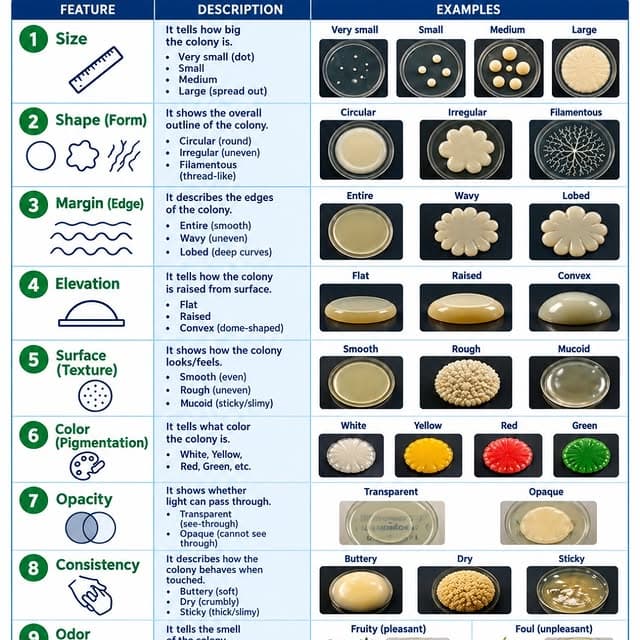
Posts🦠 COLONY MORPHOLOGY: KEY FEATURES EVERY MICROBIOLOGY STUDENT SHOULD KNOW! 🔬 How do microbiologists describe microbial colonies on agar plates? 🧫 From size, shape, margin, and elevation to surface texture, pigmentation, opacity, and consistency, colony morphology provides important clues for preliminary microbial identification. 📚 Save this infographic for your microbiology practicals, lab exams, and interviews! 💬 Quiz time: Which colony morphology feature do you find most difficult to identify? 📌 Follow @microbiologynotes and @microbiologyeducation for more microbiology notes, laboratory techniques, quizzes, and practical learning. ⚠️ Remember: Colony morphology alone cannot confirm the identity of a microorganism. Never sniff microbial cultures directly. #Microbiology #MicrobiologyEducation #microbiologylab
26 Oct 2026
Posts🦠 Microbiology Quiz Time! 🧬💉 Do you know the correct answer? Comment below! 👇 🔬 Learn with @vivekaiden about microbiology lab techniques! . . . . . . . . #Microbiology #MicrobiologyQuiz #Virology #MRNAVaccine #COVID19
25 Oct 2026
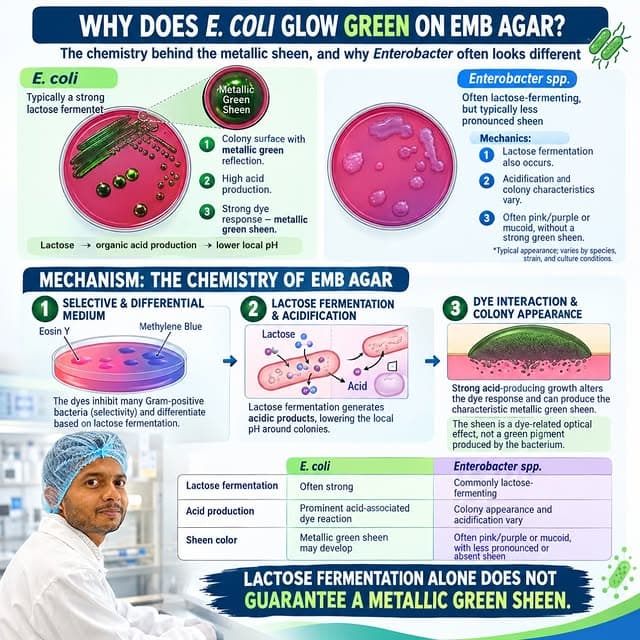
Posts🧫💚 WHY DOES E. COLI GLOW GREEN ON EMB AGAR? Ever wondered why Escherichia coli produces that distinctive metallic green sheen on Eosin Methylene Blue (EMB) agar? 🧪 The science behind the sheen: ✅ EMB agar is both selective and differential. ✅ E. coli typically ferments lactose vigorously, producing acid. ✅ Acidification influences the interaction of the dyes, resulting in the characteristic metallic green sheen. ✅ Enterobacter spp. may produce pink, purple, or mucoid colonies with a less pronounced sheen. ⚠️ Remember: Lactose fermentation alone does not guarantee a metallic green sheen. Colony appearance can vary with the organism, strain, and culture conditions. 🔬 Learn microbiology lab techniques with @vivekaiden Follow for practical microbiology knowledge, laboratory techniques, and science-backed explanations! . . . . . . . #Microbiology #microbe #MicrobiologyLab #MedicalMicrobiology #ClinicalMicrobiology
25 Oct 2026
Reels🧫 Mastering aseptic technique, one Petri dish at a time! Learn how to open a Petri dish with one hand while working inside a Biosafety Cabinet (BSC). Proper aseptic technique is essential for minimizing contamination risks and maintaining reliable microbiological results. Every small technique matters in microbiology! How confident are you with your aseptic technique? Comment below! 👇 Follow @microbiologynotes for more practical microbiology tips, laboratory techniques, and educational content. . . . . . . . . . #microbiologist #microbiologylab #laboratorytechniques #microbiologystudents #microbiome
24 Oct 2026
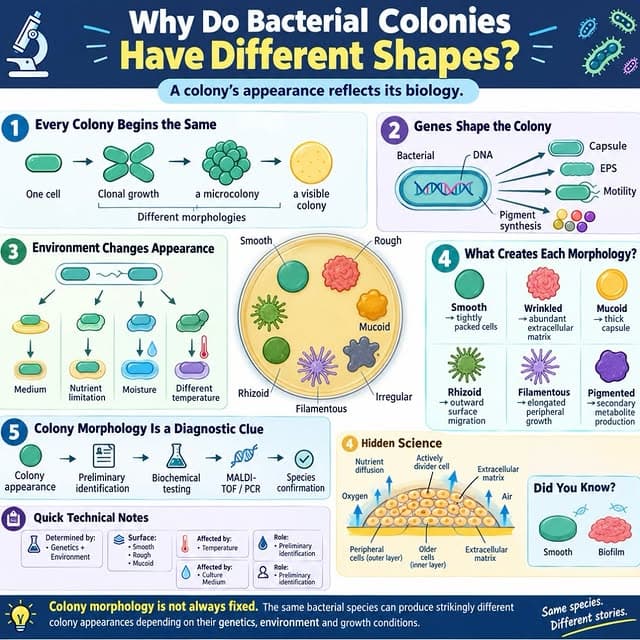
PostsWhy Do Bacterial Colonies Have Different Shapes? 🦠 Ever wondered why bacterial colonies look smooth, rough, wrinkled, mucoid, or filamentous on agar plates? Colony morphology reflects a combination of bacterial genetics, extracellular structures, and environmental conditions. 🧫 Key factors influencing colony morphology: 🔹 Genetics: Genes influence capsule formation, pigment production, motility, and extracellular matrix production. 🔹 Growth conditions: Nutrient availability, moisture, temperature, and culture medium can affect colony appearance. 🔹 Colony types: Smooth, rough, wrinkled, mucoid, rhizoid, filamentous, and pigmented colonies. 🔹 Clinical significance: Colony morphology provides valuable preliminary clues during microbial identification, but it cannot confirm species identity on its own. 💡 Did you know? The same bacterial species may show different colony appearances under different growth conditions! 👇 Microbiology quiz: Which colony morphology is associated with abundant extracellular polysaccharide production? Share your answer in the comments! Save this post for your next microbiology revision and share it with a fellow microbiologist. . . . . . #Microbiology #BacterialColonies #ColonyMorphology #MicrobiologyNotes #Bacteriology
24 Oct 2026
Microbiology Notes is a education creator with 602.8K Instagram followers, a 0.11% engagement rate and about 11K average views per post.
Also runs
We'll handle outreach, pricing and contracts — and share audience data before you commit.
Connect with this creator→@wangchuksworld
Education · India